Who is Francis Halzen? Biography, career, and discovery that won him Nobel Prize 2026
Francis Halzen wins 2026 Nobel Prize in Physics for Antarctic ‘Ghost Particle’ hunt
Published October 06, 2026
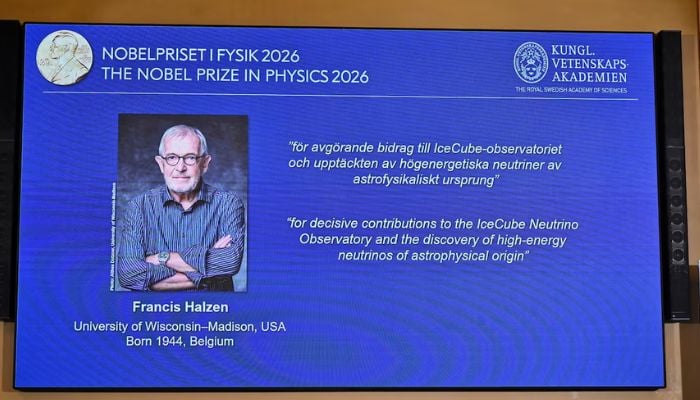
Belgian-American particle physicist Francis Halzen has been awarded the 2026 Nobel Prize in Physics for his pioneering work on the IceCube Neutrino Observatory, which detects some of the universe’s most elusive particles (high-energy neutrinos) from a cubic kilometre of pristine Antarctic ice.
Early life and education
Born on March 23, 1944, in Tienen, Belgium, Halzen earned an MSc in Physics in 1966 and a PhD in 1969 from the Catholic University of Leuven. He passed his Agrégé de l'Enseignement Supérieur in 1972.
Between 1969 and 1971, he worked as a scientific associate at CERN, the European particle physics laboratory. In 1972, he joined the University of Wisconsin-Madison, where he has been a professor ever since and now serves as the Hilldale and Gregory Breit Distinguished Professor.
The big idea
In 1988, Halzen suggested something audacious: using the vast, clear ice at the South Pole to detect neutrinos or “ghost particles” that pass through the Earth and our bodies without a trace.
He first learned of Russian attempts to detect neutrinos in Antarctica, but after determining those methods were too weak, he started to work on the AMANDA project in 1987. In this project, around four new holes were drilled at depths of 2050 m to 2180m and instrumented with 86 photomultipliers (PMTs) at depths of 1520- 2000 m to prove the concept, though cosmic ray interference and air bubbles limited results. Halzen realized a far larger detector was needed.
Building IceCube
After securing funding from European and American sources, construction began on the IceCube Neutrino Observatory in 2005, which was approximately 100 times bigger than AMANDA.
It spanned one cubic kilometer of ice and was buried up to 2,5000 meters deep near the Amundsen-Scott South Pole Station. It became fully operational in 2010.
The Nobel Prize-winning discovery
In 2013, IceCube made the first clear observation of high-energy cosmic neutrinos originating from outside our galaxy; particles about 100 times more energetic than those produced by the Large Hadron Collider.
Because neutrinos are electrically neutral and undeflected by magnetic fields, their arrival direction points directly back to their source, opening a new field: neutrino astronomy.
Career and recognition
Halzen is Principal Investigator of IceCube and Director of the Institute for Elementary Particle Physics at UW-Madison. Earlier, he earned the Balzan Prize (2015), the Bruno Pontecorvo Prize (2018), the Yodh Prize (2019), election to the National Academy of Sciences (2024), and the APS Medal for Exceptional Achievement in Research (2026). He also co-authored Quarks and Leptons, a standard particle physics textbook.
Now, the Royal Swedish Academy of Sciences awarded him the 2026 Nobel Prize in Physics “for decisive contributions to the IceCube Neutrino Observatory and the discovery of high-energy neutrinos of astrophysical origin.” The prize is worth 12 million Swedish crowns ($1.2 million).