How China is filling the Nvidia void after US chip ban
For years, Nvidia GPUs powered China’s AI models, search engines, smartphones, and driverless cars
Published December 04, 2025
The long-running rivalry between the US and China has historically driven both nations to either compete in a certain domain or, when competency is insufficient to outdo the competitor, devise policies to block the other's development.
Since modern-day warfare is driven by technology rather than artillery or weaponry, both are equipping themselves with artificial intelligence (AI) or disarming the other in a bid to surpass it.
Nvidia’s GPUs have been powering China’s AI ecosystem for years, including search engines, smartphones, driverless cars, and the current generation of generative AI models.
However, Washington’s decision to block access to Nvidia’s most advanced semiconductors, coupled with US President Donald Trump's reservation of Blackwell chips “exclusively for the US,” has forced China into building its own cutting-edge AI hardware.
Why Washington shut the door on Nvidia chips
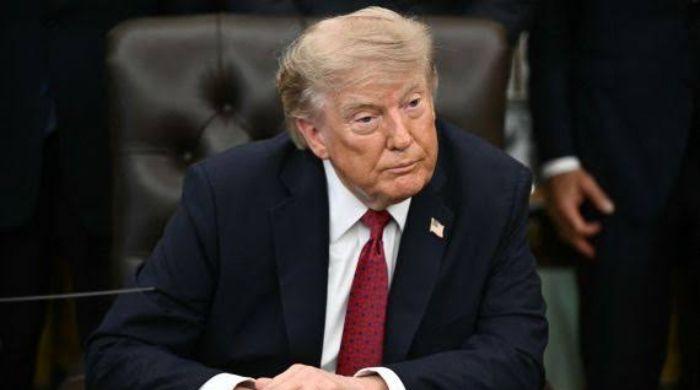
Prompted by fears of Nvidia's top-tier GPUs boosting China's military capabilities, Trump made the policy clear on 60 Minutes, stating: “The most advanced, we will not let anybody have them other than the United States… We don’t give the Blackwell chip to other people.”
The US lawmakers went an extra mile, warning that any concessions would be “akin to giving Iran weapons-grade uranium.” Yet Nvidia CEO Jensen Huang has pushed back, calling the ban a tactical misstep. He noted that “depriving someone of technology is not a goal, it’s a tactic—one that was not in service of the goal.”
Half of the world’s AI engineers are Chinese, and isolating them could accelerate China’s domestic alternatives rather than slowing them, according to Huang.
Huawei leading China’s self-sufficiency in AI chips, GPUs
Operating under the U.S. sanctions since 2019, Huawei has built a parallel AI-computing universe, which is an indication that no other company has the potential to bring China’s determination to life. Huawei's Ascend series—910B, 910C, and upcoming 950/960/970—stands as China’s contenders against Nvidia.
While Huawei's 910B roughly matches Nvidia’s older A100, the newer 910C is designed to deliver H100-level performance through an aggressive chiplet design.
In a bid to counter Nvidia’s single-chip advantage, Huawei unveiled massive supercomputing clusters like the Atlas 900 A3 and plans even larger Atlas 950 and 960 SuperPoDs, connecting thousands of Ascend chips to generate exaflops of compute.
Huawei’s software ecosystem has also attained the same calibre of greatness.
Its MindSpore and CANN frameworks offer domestic alternatives to essential tools, PyTorch and CUDA, used by Nvidia to maintain global dominance.
A huge coalition of state-backed firms (iFlytek, SenseTime, 360), working alongside ByteDance and Baidu, is already testing Huawei hardware.
Notwithstanding the developments that enable it to thrive against Nvidia, Huawei must address political scepticism, as telecom giants such as China Mobile are avoiding becoming overly dependent on any single vendor, therefore joining hands with various supply chains.
Alibaba and Baidu bring Nvidia alternatives for industrial use
With China devoid of Nvidia, Alibaba’s chip division T-Head has grown into a strategic national asset from a modest RISC-V experiment. Its newest PPU chip, armed with 96 GB high-bandwidth memory and PCIe 5.0, is being deployed at an enormous scale in China Unicom data centres.
With over 16,000 PPUs currently operating, the chip is an arch-rival to Nvidia’s H20. Backed by Panjiu supernode servers, Alibaba Cloud is architecting a full stack of domestic AI hardware for commercial use.
On the other hand, Baidu took the industry by storm in 2025 by switching to a 30,000-chip Kunlun P800 cluster, capable of training DeepSeek-like models with tens of billions of parameters. The P800’s performance matches Nvidia’s A100 and Huawei’s 910B.
Further complementing China's ambitions of self-sufficiency, Kunlun chips have already secured more than $139 million in orders from China Mobile, and Baidu has committed to releasing a new AI chip every year until 2030.
Rise of China’s new generation of AI chip champions
Beyond the giants like Huawei, Alibaba and Baidu, a new wave of AI chip designers has also emerged, with the most prominent players including Cambricon, Moore Threads, Biren, MetaX, Enflame, and Hygon.
DeepSeek also boosted investor sentiments by announcing that the latest DeepSeek model will be powered by upcoming Chinese chips, propelling Cambricon to the top of Chinese stock charts by valuation.
Yet, many of these startups are also faced with hurdles like limited fabrication capacity, U.S. blacklisting, high R&D costs, and small customer bases. But stock market analysts believe the market will bring to light two to three national champions.
Instead of slowing China down, Washington’s Nvidia ban seems to have ignited one of the fastest, most coordinated hardware pushes in Chinese history, with tech giants like Huawei, Alibaba, and Baidu expediting efforts to rebuild an AI stack once dominated by Silicon Valley.
But the question that remains unanswered is whether these efforts will surpass Nvidia, and the only certainty in sight is that China is not letting its AI future depend on U.S. chips.