China's regreening efforts activate water cycle but with hidden cost
Greener landscapes improve soil stability, biodiversity and carbon absorption
Published December 05, 2025
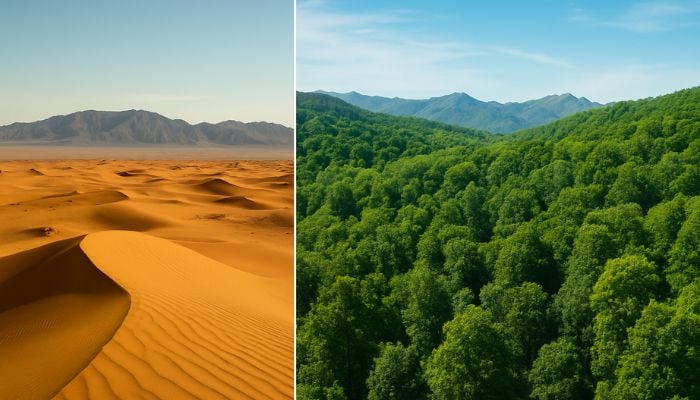
China's huge “regreening” efforts across the country over the past few decades have started bearing fruit as a recent study reveals that the country’s water cycle has been activated.
For context, the water cycle is Earth's way of recycling water: the sun heats water, causing evaporation, which rises, cools, and forms clouds (a process known as condensation). The water then falls back as rain, flowing into rivers and oceans to start over, making it a continuous cycle from Earth to sky and back again.
According to a study published in the journal Earth’s Future, the regreening efforts and changes in vegetation have changed the amount of water availability for humans living across around 74 per cent of China’s land area.
Experts discovered that water availability increased in the Tibetan Plateau region, whereas it decreased in eastern monsoon and northwestern arid regions.
The study’s co-author, Arie Staal, who also serves as an assistant professor of ecosystem resilience at Utrecht University in the Netherlands, said, “Land cover changes have redistributed water.”
He added that China’s efforts have reactivated the water cycle and restored the thriving ecosystems in the region.
Researchers believe that it is beneficial as well as risky to some extent, adding, “greener landscapes improve soil stability, biodiversity and carbon absorption.”
However the increase in evapotranspiration resulted in many densely populated and agriculturally important areas receiving less water than before.
Experts have urged governments to implement water management strategies in parallel with large scale environmental projects to prevent any possible water crises.