Trump neither Cold War hawk nor warmonger: ex-federal minister
"US president has some very soft language towards Russia and China," says Hussain
Published December 18, 2025
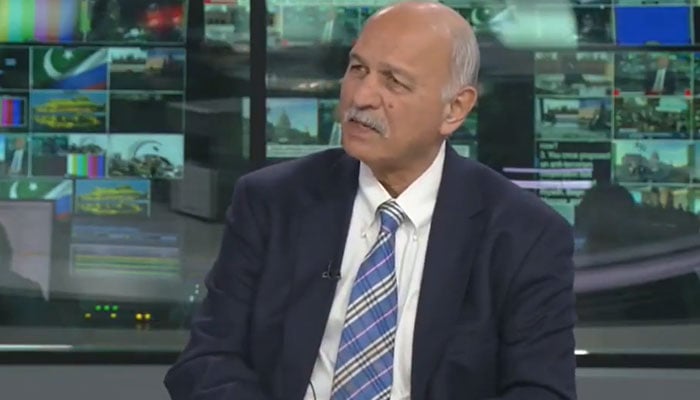
MOSCOW: Former federal minister Mushahid Hussain Sayed has said that US President Donald Trump is neither a “Cold warrior nor a warmonger”.
In an interview with Russian state broadcaster RT, Hussain, while referring to the national security strategy of President Trump, said the US president has some very soft language towards Russia and China.
“I think that means that the folks in Washington under President Trump, who I feel is not a cold warrior nor a warmonger. He sees us more as a partner, perhaps in development on stability in Europe,” he added.
The former senator said he thinks there's a lingering Cold War mentality in NATO and in certain parts of Europe.
“[Former US president Joe] Biden used to have that, I think there's no room for that anymore,” he added.
The former lawmaker said that they feel the global balance of economic and political power is shifting from the traditional West, the US and Europe, to what they see as the global South and with Eurasia, of which Pakistan and Russia are partners, as the centre of gravity of the global South.
Speaking at the first-ever Pakistan-Russia Eurasian Forum 2025 in the Russian capital, Mushahid, a day earlier, had said that Pakistan and Russia are strategic partners in Eurasia.
He had announced the establishment of a new Eurasian Connectivity Forum aimed at strengthening regional cooperation and people-to-people links.
In his keynote address, the former senator had said that the global shift of power from West to East was now evident.
He had noted that even the US president’s National Security Strategy had acknowledged this reality.
Mushahid had said Eurasian multilateralism would shape the emerging multipolar world, with Pakistan, Russia, Iran, Turkey and the Central Asian republics playing a leading role.
In this context, he had announced the Eurasian Connectivity Forum as the institutional foundation of Eurasian multilateralism, stressing that connectivity encompassed commerce, culture and people-to-people exchanges, with media, academia and think tanks as key stakeholders.
He had said counter-terrorism, commerce and culture, education and energy, and people-to-people connectivity would form the core pillars of the Eurasian Connectivity Forum.