GPT-Rosalind explained: OpenAI's new AI model for drug discovery, Biology
OpenAI is already working with several major players in the biotech and pharmaceutical industries
Published April 18, 2026
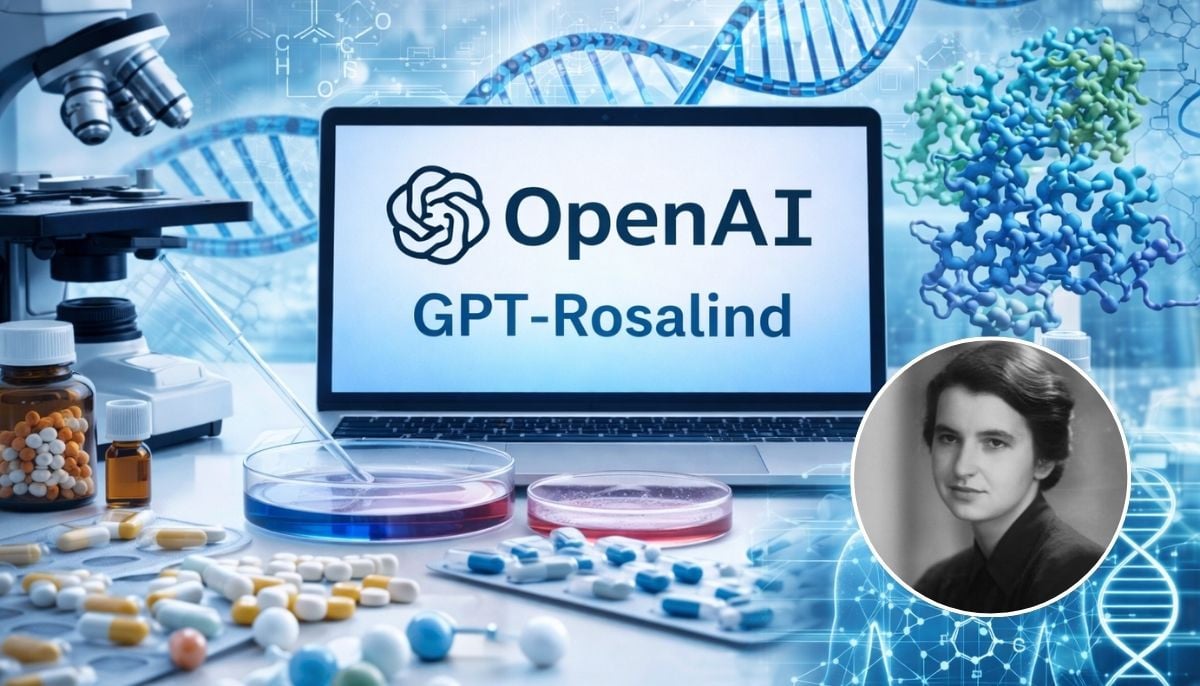
OpenAI has launched a new artificial intelligence (AI) model, known as GPT-Rosalind Franklin, with the aim to speed up research in biology, drug discovery, and medicine. It is named after Rosalind Franklin, the British scientist who played a key role in discovering the structure of DNA.
The model is built to handle complex scientific work across published research, biological data, laboratory tools, and experiments. It performs best on tasks that involve reasoning over molecules, proteins, genes, and disease biology.
GPT-Rosalind is designed to work through multi-step scientific workflows, including literature reviews, analysing genetic sequences, planning experiments, and processing research data.
The San-Francisco based company claims its new AI model can surface connections that researchers might otherwise miss and help scientists reach better conclusions faster.
According to OpenAI the progress in the life sciences is held back not just by the difficulty of the science, but by the sheer complexity of the research process itself. It believes that advanced AI can help researchers move through those workflows more efficiently.
"We believe advanced AI systems can help researchers explore more possibilities and arrive at better hypotheses sooner," the company said in its announcement.
It described GPT-Rosalind as the beginning of a long-term commitment to building AI that can drive scientific discovery in areas that matter to society.
OpenAI is already working with several major players in the biotech and pharmaceutical industries, including Amgen, Moderna, the Allen Institute, and Thermo Fisher Scientific.
Moderna's CEO Stephane Bancel said the model is already showing promise, adding that it can bring together complex data and turn those insights into practical experimental workflows, with the potential to speed up research and development.
GPT-Rosalind is part of a broader push by OpenAI into health and medical research. The company is developing new AI models and forming partnerships with global pharmaceutical firms.
OpenAI announced a partnership with Danish pharmaceutical giant Novo Nordisk with the goal of helping the company bring new and better treatments to patients more quickly.
OpenAI CEO Sam Altman said: "AI is reshaping industries, and in life sciences, it can help people live better, longer lives."