Super El Nino raises risk of polar vortex collapse this winter
Super El Nino threatens $3 trillion in global economic losses, study finds
Published July 23, 2026
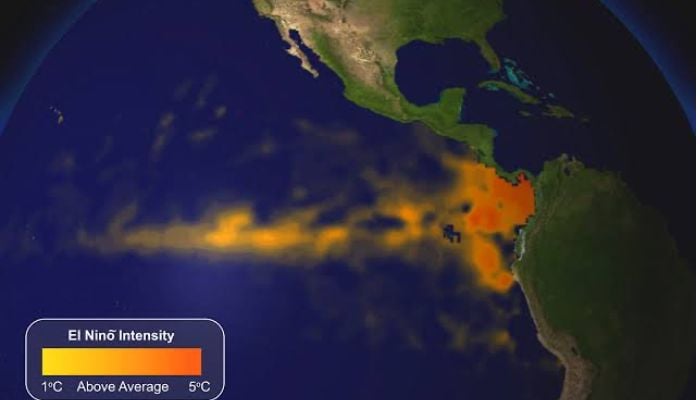
Recent meteorological data suggests that the 2026 El Niño is rapidly intensifying, with forecasts pushing the event deep into “Super El Niño” territory.
Scientists warn that there are chances that this can become the strongest El Niño event in recorded history, with atmospheric impacts already becoming clearly visible across the globe.
The Pacific Ocean is warming, with a rising current and lower pressure taking shape in the central and eastern Pacific. The tropical influence is already influencing global atmospheric circulation, changing pressure patterns and moving the jet stream with the advance of the season towards winter.
A Super El Niño occurs when sea surface temperatures rise by more than 2.0°C above the long-term mean. All predictions of several meteorological centres, including CFSv2, ECMWF, and Australian BOM, suggest that the El Niño in 2026 will be more than 3°C, making it the most powerful El Niño in the last 155 years.
The event is also powered by strong subsurface Kelvin waves, with ocean temperatures peaking over 7°C above normal at depth. These warm anomalies are rising to the surface, releasing massive amounts of energy into the atmosphere and creating an “atmospheric standing wave.”
For the United States and Canada, forecasters are predicting an extremely amplified pattern characterised by a block of high pressure in Canada. The result will be a movement of the polar jet stream northward, hence warm temperatures in the northern states and western Canada, but a strong southern jet stream that will cause a storm in the southern and eastern United States.
In the January forecast, there will be widespread sub-normal temperatures in the Central, Southern, and Eastern United States, which will continue into February, but there will be above-normal precipitation throughout the southern United States.
Historically, the trend has shown that Super El Niño drives the sudden stratospheric warming event, which can disrupt the Polar Vortex and release cold Arctic air southward. Seasonal forecasts already show a strong polar vortex disruption trend for January and February 2027, potentially unlocking a bitter cold for North America and Europe.
Beyond weather, the Super El Niño is also predicted to drag down the global economy by an estimated $686 billion in year-one losses alone, with five-year cumulative losses reaching around $3.1 trillion. The hard-hit countries will be lower- and middle-income nations in the tropics, including Ecuador, Peru, Indonesia, and Malaysia.