Elon Musk unveils Tesla Roadster that can fly, flip mid-air, hit 60 MPH in under one second
Tesla Roadster comes with a top speed exceeding 230 mph and a driving range of around 300 miles
Published October 16, 2026
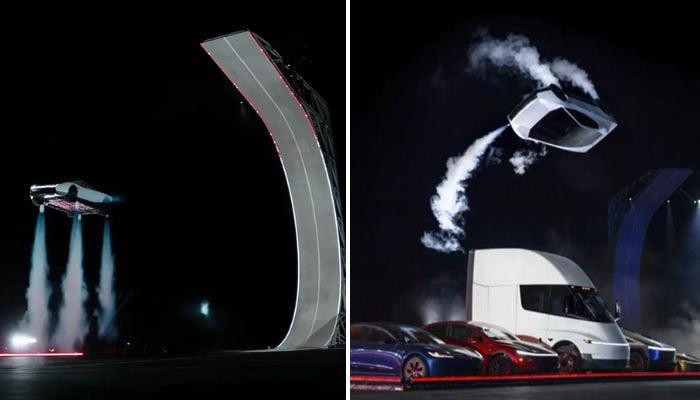
Space CEO Elon Musk has unveiled Tesla's long-awaited next-generation Roadster that does some things which no ordinary sports car can, i.e. launch itself into the air, perform flips and land back on its wheels.
Nearly nine years after Tesla first announced the project, the billionaire demonstrated the world’s first electric-powered supercar at a SpaceX facility in Texas.
The videos of the demonstration have gone viral on social media as it marks the appearance of a flying car for the first time ever.
In one demonstration, the Roadster climbed a massive curved ramp, drove upside down and then launched into the air before flipping and landing safely.
"Well, it worked," Musk said after the stunt.
The car later jumped over a lineup of Tesla vehicles using rocket-style thrusters developed with SpaceX.
"Turns out the future does have flying cars," Musk wrote on X.
But the Roadster isn't just about flying. Tesla claims it can accelerate from zero to 60 mph in less than one second, with a top speed exceeding 230 mph and a driving range of around 300 miles.
Tesla is offering three versions: Performance, Thrust and Rocket. The Rocket variant, equipped with a full flight system, will be available by invitation only.
Getting one won't be cheap. Tesla is asking for a $50,000 deposit for the Performance model and $250,000 for the Thrust version.
There's another catch: customers won't receive their cars until at least 2028, assuming Tesla meets its latest production target.
The flying feature also isn't approved for public roads.
Musk first unveiled plans for the second-generation Roadster in 2017, initially promising deliveries in 2020. Several deadlines have since passed.
For now, Tesla has demonstrated a car capable of spectacular airborne stunts, but turning that technology into a road-legal production vehicle remains another challenge.