NASA's PUNCH mission offers first-ever views of continuous solar eruptions in space
Scientists traced huge solar eruptions in Sun's outer atmosphere into interplanetary space
Published December 20, 2025
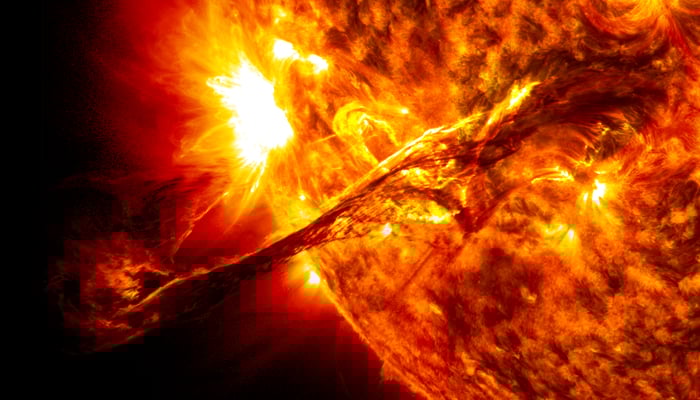
Celestial happenings are surely a feast for skygazers, and this particular fraternity is what NASA's NASA's Polarimeter to Unify the Corona and Heliosphere (PUNCH) mission has served by providing the first-ever continuous display of eruptions in space.
Displaying coronal mass ejections (CMEs) from October 21 to November 12, 2025 for the first time, these massive solar eruptions were traced by scientists in the Sun's outer atmosphere into interplanetary space.
The mission came to fruition with four small spacecraft that captured refined images of CMEs, which appear as cloud-like features moving away from the Sun.
The spacecraft carrying out the observation also recorded celestial objects like comet Lemmon, Venus, and Mercury. This data is particularly valuable for enhancing our understanding of space weather and its effects on Earth and the solar system.
By forming wide-field mosaics of the Sun's corona and solar wind, PUNCH detected multiple CMEs, including a significant G4-class storm that took place in mid-November, producing visible auroras across several U.S. states.
This data can be utilised for predicting disturbances to satellites, power grids, and human activities in space.
Craig DeForest, PUNCH principal investigator at Southwest Research Institute, emphasised the importance of these Level 3 images, noting that they enable tracking of CMEs and estimation of their impact on Earth as they unfold.
The PUNCH mission is said to keep updating its observations, collaborating with other NASA missions, such as the Parker Solar Probe and Solar Orbiter, to provide a comprehensive understanding of solar eruptions and their impact on space weather.