Natural Resources of Venezuela: Overview of oil, natural gas, rare earth minerals
Venezuela holds one of the largest oil reserves in the world
Published January 05, 2026
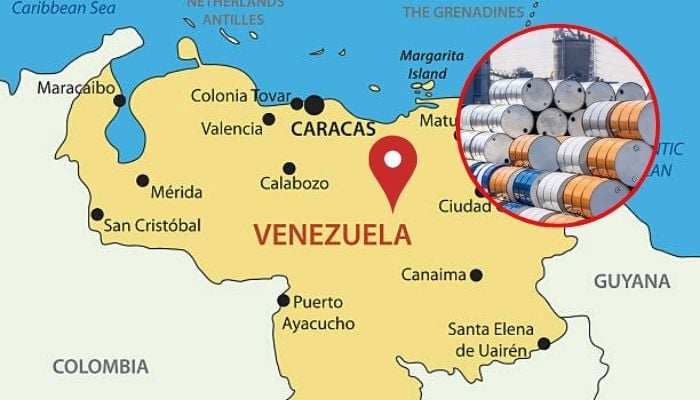
The Bolivarian Republic of Venezuela is located alongside the South America’s Caribbean coast. Its neighbouring countries are Brazil and Columbia. Having a total area of 912,050 km2 and a land area of 882,050 km2, Venezuela is enriched with natural resources.
Natural resources include petroleum, natural gas, iron ore, gold, bauxite, diamonds, and other minerals.
Oil
The country holds one of the largest oil reserves in the world and is a founder member of Organisation of Petroleum Exporting Countries (OPEC).
Statistical Review of World Energy revealed that proven oil reserves of Venezuela were around 300 billion barrels (4.8x10¹⁰m3) as of January 1, 2014.
However, the 2019 BP Statistical Review of World Energy reveals that Venezuela's total proved reserves rose to 303.3 billion barrels, which is slightly more than Saudi Arabia (297.7 billion barrels).
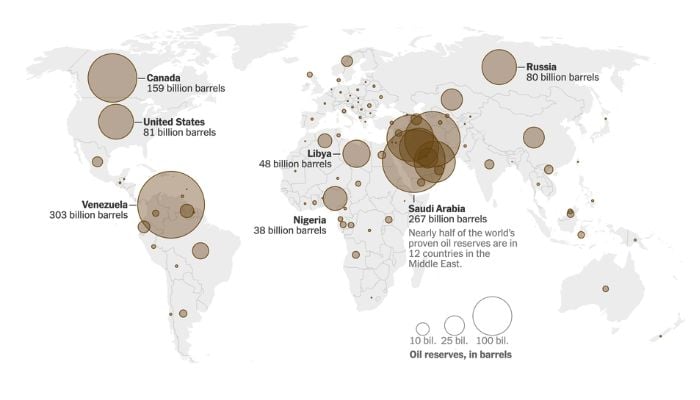
Besides conventional oil reserves, Venezuela has oil sands deposits similar in size to those of Canada in the Orinoco Belt. They are approximately equivalent to the world’s reserves of conventional oil.
It is reported that around 100 billion barrels to 270 billion barrels are the recoverable reserves of the Orinoco Belt. According to the United States Geological Survey (USGS), the Orinoco Belt alone contains 900-1,400 billion barrels of heavy crude in proven and unproven deposits.
Of this, only 380-652 billion barrels can be technically recoverable. This makes the country’s total reserves (proven and unproven) among the largest in the world.
Gold
Venezuela has significant gold resources, mainly located in the Guiana Shield in the southeast of the country. Gold mining began in the 1800s, and by the early 1970s, about 187 metric tons had been officially produced. The El Callao district is Venezuela’s most crucial gold area, having produced over 124 metric tons of gold and once being the world’s leading gold mine. Other districts, such as Kilometer 88, Lo Increíble, and Marwani, also contain gold in similar geological settings.
Diamond
Venezuela is also naturally endowed with diamonds. Its Guiana Shield is the central diamond-producing region. The Quebrada Grande area and the San Salvador de Paul mine have historically been the most prominent producers, reportedly accounting for over 90% diamond production in the 1975-1980 period.
Iron
Venezuela also has significant iron resources, mainly in banded iron formations (BIFs) of the Archean Imataca Complex. Currently, the high-grade reserves have exceeded 1,866 million metric tons at Cerro Bolivar, San Isidro, and Los Barrancos, grading about 63% iron. Combining with lower-grade materials, total reserves can reach up to 8,000-10,000 million metric tons.
Aluminum
After oil, Venezuela’s alumina industry is the second-largest foreign-currency earner. In 1987, the country produced about 1,347,000 mt of alumina and 428,000 mt of aluminum metal. Significant deposits are found at Los Pijiguaos, Upata, Nuria, Los Guaicas, and Gran Sabana. Los Pijiguaos alone holds around 700 million mt of proven and potential reserves.
Manganese
Manganese deposits are present in the greenstone belts of the Archean Imataca Complex, at locations such as San Cristobal, La Esperanza, El Palmar, Guacuripia, Upata, and El Pao. The ores are secondly enriched, containing pyrolusite, cryptomelane, and psilomelane, with total reserves in the Upata-El Palmar-Guacuripia area around 1 million mt, averaging 20-25% Mn.
Tin
Tin occurs in placer, eluvial, and lode deposits in western Bolivar State and Amazon Federal Territory, especially around Cano Aguamena. Alongside Tin, associated minerals include cassiterite, tantalum, niobium, zirconium, and titanium minerals. Although resources are not well-defined, drill samples show 0.01-0.77% tin in heavy minerals.
Niobium, Tantalum, Rare Earth Minerals (REE)
These are primarily linked to pegmatites in Parguaza granite and the Imataca Complex, with the richest deposit at Cerro Impacto, a weathered carbonatite. Lateritic soils here are enriched in Fe, Mn, Al, Ba, Th, Nb, Ti, and REE (Cerium, Lanthanum, and Neodymium). Other minerals include gorceixite, goyazite, florencite, bastanaesite, and monazite. The most significant source is Cerro Impacto.
Uranium
Uranium occurrences are scattered, primarily as radiometric anomalies in the Guiana Shield. Key areas include the Churuata ring structure and parts of the Roraima Group.
Venezuela is endowed with abundant natural resources, including petroleum, minerals, and metals, offering significant economic potential, though many deposits remain underexplored, and development varies across regions.