‘No broken bones, no crime': Taliban legalises domestic violence
Animals get more rights than women under new Taliban law
Published February 21, 2026
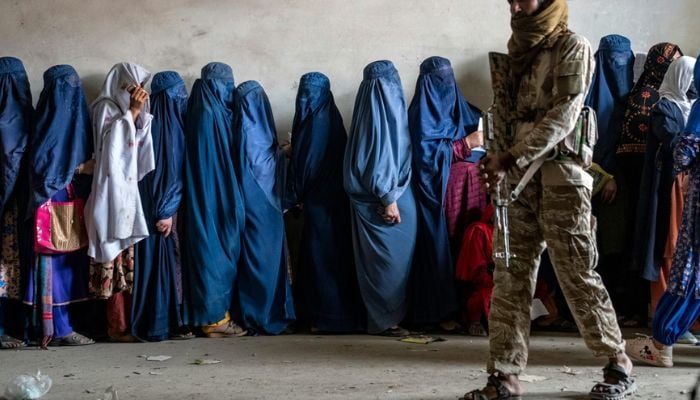
Taliban leadership in Afghanistan has formally enacted a new, 90-page penal code legalising domestic violence against women.
The document is signed by Supreme Leader Hibatullah Akhundzada, establishing a discriminatory “caste system” for criminal punishments.
The regulation was made public in late January 2026, putting the final nail in the coffin for Afghan women’s autonomy.
Violence without “broken bones”
The most harrowing aspect of the new code is its treatment of domestic abuse. Under the new law, husbands get the legal right to physically punish their wives and children, unless the violence doesn’t result in “broken bones or open wounds.”
In case of “obscene force” where a victim has visible fractures or severe injury, the legal consequences are very minimal.
The law stipulates:
- Sentencing: A husband may face a maximum of 15 days in prison in case of serious physical trauma.
- Burden of Proof: The victim must provide the evidence of abuse, which is nearly impossible in the Afghan court, as women are required to be fully covered and must be accompanied to the hearing by a male chaperone (which in most cases is the very person accused of the abuse).
The tragedy is that rather than granting women their rights, the code mandates a “three-month prison sentence” for any married woman who visits her relatives without her husband’s explicit permission.
A four-tiered caste system
Article 9 of the code officially abandons the principle of “equality before the law.” It divides the society into four distinct ranks. The punishment for a crime is dictated on the basis of the rank of the offender in society instead of the severity of the act.
| Social Class | Legal Consequences for Crimes |
| Religious Scholars (Ulama) | Limited to "advice" or a verbal warning |
| The Elite (Ashraf/ Tribal Elders) | A formal summons to court and advice |
| Middle Class | Subject to imprisonment |
| Lower Class | Subject to threats, imprisonment, and corporal punishment |
According to Article 15 of the code, which explicitly mentions “free” and “enslaved” persons, that is a direct violation of the absolute global ban on slavery and servitude.
Vigilante “justice” and moral policing
The decree further decentralises violence by authorising “vigilant” punishment. As reported by the Independent, under this rule, any citizen who witnesses a perceived “sin” is now empowered to impose “ta’zir” (discretionary punishment) on the spot to “prevent vice.”
Moreover, on a hierarchy established by the code, animal welfare is valued over women’s safety.
While domestic abuse only results in 15 days of imprisonment, Article 70 mandates “five months prison” for anyone caught forcing animals or birds to fight.
Reem Alsalem, UN Special Rapporteur on violence against women, said: “The implications of this latest code for women and girls is terrifying. The Taliban have correctly understood that no one will stop them. Will the international community prove them wrong?”
Rawadari, an Afghan-led human rights organisation, reported that Afghans are terrified to speak out because the Taliban has declared that even “discussing” the new code is a criminal offense.