Provinces resist Centre's bid to shift HEC, BISP, PSDP costs
Despite tensions, NFC agrees merged tribal districts will be counted in future KP share

Published December 05, 2025
- Provinces say NFC cannot apportion federal expenditures.
- Centre warns debt servicing has exhausted post-7th Award space.
- FBR, finance officials urge stronger revenue mobilisation nationwide.
ISLAMABAD: The provinces, particularly Sindh and Khyber Pakhtunkhwa (KP), strongly opposed the federal government’s move to shift selected expenditures onto provincial budgets during the maiden session of the National Finance Commission (NFC) held on Thursday, The News reported.
Chaired by Finance Minister Muhammad Aurangzeb at the Finance Division, the first NFC sitting opened with the Centre painting a bleak fiscal picture. Federal officials contended that national coffers had effectively run dry over the past 15 years, with debt servicing alone consuming all available resources in the post-Seventh NFC Award period.
The federal government shared a 30-year fiscal breakdown comparing the pre-Seventh NFC era (1995–2010) with the post-award period (2010–2025), noting that the annual fiscal deficit had swollen from around 4% to between 6.6% and 7%.
With 57.5% of the Federal Divisible Pool (FDP) now flowing to the provinces, Islamabad argued it still spends an additional 15% on provincial functions, forcing it to borrow heavily and fuelling debt accumulation. The Centre urged provinces to ramp up their own revenue generation to meet rising expenditures.
However, the provinces pushed back, urging the Centre not to “dictate” provincial responsibilities. They rejected federal suggestions that provinces should assume financial responsibility for the Higher Education Commission (HEC), Benazir Income Support Programme (BISP), and development projects traditionally executed under the Public Sector Development Programme (PSDP).
The provincial representatives insisted that the NFC’s mandate was to decide the vertical and horizontal revenue distribution formula, not to apportion federal expenditures. They maintained that the Centre cannot question how the provinces utilise transferred funds under the NFC framework. Sindh took a particularly firm stance, asserting that under the NFC constitutional framework the federal government has no authority to challenge provincial spending decisions. Sindh also objected to the proposed Terms of Reference (ToRs), prompting the federation to respond that any disputes over ToRs should be referred to the president.
Amid the disagreements, the session did achieve a rare consensus: all sides agreed to formally recognise the merged tribal districts within KP as part of future NFC considerations. KP’s chief minister argued that the Seventh NFC Award had become outdated after the 18th Amendment, as key subjects, including population and education, had been devolved, while the province continued to bear the high financial cost of terrorism.
KP’s finance adviser added that the province’s development share, as a percentage of GDP, had fallen below its 2005 level. The next NFC session is expected to revisit these contentious issues as federal-provincial tensions over resource sharing continue.
Speaking to reporters outside the Q Block (Ministry of Finance), Sindh Chief Minister Murad Ali Shah said the NFC meeting was held in a “congenial environment”, noting that the maiden session of the forum had earlier been postponed because of floods. He added that all stakeholders agreed a joint press release would be issued.
KP’s Finance Adviser Muzammil Aslam told the media that the Centre had reiterated its position that it was left with “no money” after meeting debt servicing obligations. Punjab assured full cooperation in the renewed NFC process.
Its finance minister said the province had presented a budget surplus and eliminated all domestic borrowing, carrying only external debt on its books. Meanwhile, Balochistan’s finance minister argued that despite supplying local gas and hosting Reko Diq, the province continued to receive an unjustly low share of national resources.
Senior federal officials, including the finance secretary and FBR chairman, also briefed the meeting. The FBR chairman stressed that both federal and provincial governments were collecting far below their tax potential, emphasising the need for stronger revenue mobilisation nationwide.
Finance Secretary Imdadullah Bosal said the federal government had been compelled to borrow repeatedly in the post-seventh NFC Award era, as expenditures kept rising without corresponding growth in revenue space, severely straining Islamabad’s fiscal position.
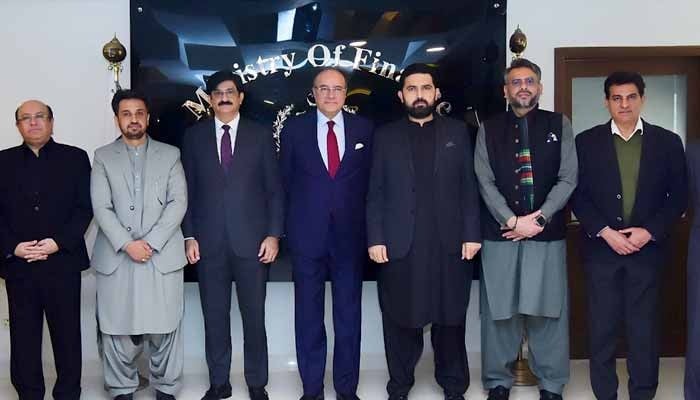
According to the Finance Ministry’s official press release, the inaugural meeting of the 11th National Finance Commission (NFC) was chaired by Federal Finance Minister Senator Muhammad Aurangzeb, with all four provinces represented at the chief minister or finance minister level, alongside their designated NFC members. KP’s Finance Adviser Muzammil Aslam also attended on special invitation.
Welcoming the participants, Senator Aurangzeb highlighted the constitutional significance of the NFC and reaffirmed the federal government’s commitment, on the prime minister’s direction, to holding the session without further delay.
He noted that the meeting had previously been postponed because of the devastating floods in Punjab, KP and Sindh, but said the successful convening of the forum reflected a shared resolve to meet national responsibilities.
The finance minister stressed transparent and sincere dialogue, assuring provinces that the Centre was present to listen and work collaboratively. He praised provincial cooperation in signing the National Fiscal Pact and their efforts to deliver mandatory fiscal surpluses to help Pakistan meet IMF requirements.
Despite external pressures and natural disasters, the minister said both federal and provincial governments had shown unity and resilience. He expressed confidence that this spirit would continue, stressing that the NFC plays a vital role in equitable resource distribution, fiscal sustainability and long-term economic growth.
Senator Aurangzeb said he expected meaningful, inclusive deliberations leading to a fair and forward-looking NFC Award. Sindh CM Murad Ali Shah agreed that advancing the 11th NFC with consensus was essential and reaffirmed Sindh’s commitment to Pakistan’s unity and prosperity. He stressed that consensus must be built within the NFC forum itself and that the commission must adhere strictly to its constitutional mandate.
KP’s chief minister thanked the federal government for convening the session and said a strong federation depends on strong provinces. He highlighted KP’s sacrifices in the war on terror and urged that the 11th NFC correct what he described as ‘ultra vires’ issues in the 7th NFC since 2018, particularly by incorporating the population and variables of the newly merged districts into KP’s share. He asked other provinces to support KP’s demand for a constitutionally complete representation.
Punjab’s Finance Minister Mian Mujtaba Shuja ur Rehman also welcomed the meeting, noting that consensus would require serious effort but was vital for equitable resource distribution and policy consistency between the Centre and provinces.
Balochistan’s Finance Minister Mir Shoaib Nosherwani echoed these sentiments, stressing Balochistan’s longstanding cooperation with the federation and citing contributions such as Sui gas, Saindak and Reko Diq.
The meeting included broad discussions on strategy for the 11th NFC Award, followed by detailed presentations from all the provinces and the federal government on their fiscal positions and priorities. They helped build a shared understanding of economic challenges and expectations. The commission also reviewed the schedule for future sessions and agreed to form technical subgroups to work on specialised areas.
A key decision was the creation of a dedicated sub-group on the merger of former FATA/newly merged districts and their share in the divisible pool, with recommendations expected by mid-January 2026. The session concluded with all members reaffirming their commitment to a transparent, collaborative and professional NFC process aimed at delivering an equitable and sustainable award for the people of Pakistan.
Separately, Saudi Arabia extended the maturity of its $3 billion deposit with Pakistan for another year, the State Bank of Pakistan (SBP) announced. The deposit – first placed with the SBP in 2021 and rolled over since – was due to mature on December 8. The Saudi Fund for Development (SFD) approved the latest extension, which the central bank said would help strengthen Pakistan’s foreign exchange reserves and support economic stability.
The rollover comes days before the IMF Executive Board meets on Monday to consider Pakistan’s next $1.2 billion tranche. Islamabad and the IMF reached a staff-level agreement in October under which Pakistan is expected to receive $1 billion under the Extended Fund Facility (EFF) and $200 million under the Resilience and Sustainability Fund (RSF).
Analysts say the Saudi extension offers much-needed breathing space. Saad Hanif, head of research at Ismail Iqbal Securities, said the move helps stabilise SBP’s reserves but also highlights Pakistan’s continued dependence on rollover support rather than stronger exports, investment and competitiveness.
According to SBP data, foreign exchange reserves rose by $14 million to $14.57 billion for the week ending November 28, although total liquid reserves declined slightly to $19.589 billion because of a $31 million drop in commercial banks’ holdings. SBP’s reserves currently cover 2.76 months of imports, with projections of $15.5 billion by December 2025 and $17.8 billion by June 2026.