What is dark energy? Scientists say they're closer than ever to universe's hidden side
Decades after its discovery, dark energy comes into sharper focus
Published January 26, 2026
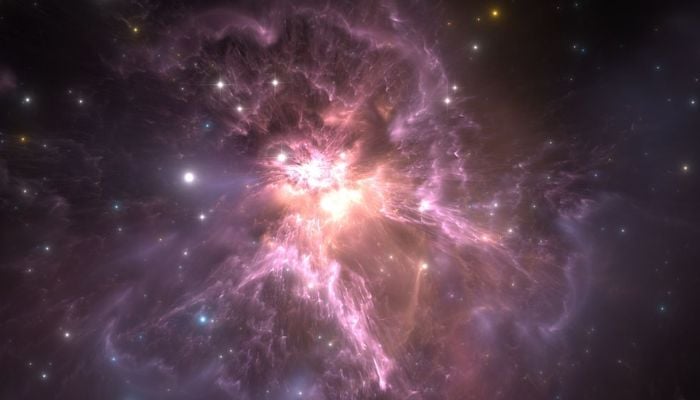
Scientists have produced the most detailed picture yet of the “dark universe,” unveiling the latest insight into dark energy.
The findings come from an analysis of six years of data collected by the Dark Energy Survey (DES), which used the powerful Dark Energy Camera (DECam) mounted on the Victor M. Blanco4-metre telescope in Chile.
Between 2013 and 2019, the survey covered one-eighth of the sky's nighttime view over 758 nights and charted the location and shape of nearly 669 million galaxies, billions of light-years away from the Earth.
For the first time in history, scientists combined four independent techniques for studying dark energy into a single, unified analysis.
This technique, however, has helped double the precision of constraints surrounding the behaviour of dark energy, constituting an important step towards understanding this major driving force, which accounts for 68% of total energy within the universe.
In 1998, dark energy was first discovered through observations of distant supernovae, which unveiled that the expansion of the universe is accelerating instead of slowing down.
Since then, scientists have been unable to explain the true nature and the driving factor behind why its influence became dominant only several billion years ago.
A new analysis of DES data reviewed the evidence on supernovae, weak gravitational lensing, galaxy clustering, and baryon acoustic oscillations—nuances that were imprinted on matter just after the Big Bang. These techniques were then employed to create a history of the distribution of matter that spans the last six billion years.
The results agree well with the standard model of the cosmos, also referred to as Lambda Cold Dark Matter, but also confirm the growing concern about the clustering of matter in the current cosmos.
For future research, scientists plan to combine DES data with upcoming observations from the Vera C. Rubin Observatory, which is expected to map billions more galaxies and provide an even clearer picture of the dark universe.