The Odyssey (2026) — Nolan drags gods to earth in majestic adaptation
In 'The Odyssey (2026)', Nolan puts heroes to the test and turns the ocean into a force of its own
Published July 23, 2026
Two days before everyone’s sights were set firmly on the contest – and subsequent outcome – of the 2026 men’s football World Cup, cinemas across the world set screenings for the tale of another audacious and arduous clash, celebrated for its grit yet again three millennia later.
Unlike the football final won by the gallant Spain against the deceptive Argentina, the cinematic retelling of Homer’s valiant epic by Christopher Nolan reeled audiences in for the reputable victory of the famously trickster army of Ithaca’s king and Greek hero, Odysseus.
The Odyssey (2026) combines the most well known parts from the ancient epic, even those wrongly attributed to it, but engaging enough to still make the cut (like the Trojan Horse fable, not part of Homer’s tale, but an addition by Roman poet Virgil in his own retelling about the fall of Troy, titled Aeneid).
And that’s the detail that really gets the ball rolling in Nolan’s favour.
Christopher Nolan’s hit tenet (for once)
If there was ever a film from Nolan’s oeuvre which best demonstrates his fascination with time, Odyssey just became that.
With a runtime of nearly three hours (capped at two hours and fifty-three minutes to accommodate IMAX format restrictions), the latest release barely ever slows down. Even when the film slithers sweetly across the plains of certain narratives woven among the plot, the concentration never once grows stagnant.
Nolan’s trusted editor since the ill-fated Tenet, and one Oscar win for Oppenheimer later, Jennifer Lame returned to cut The Odyssey for the tenacious British director. Their last collaboration about the hydrogen bomb pioneer ran for a complete three hours and, much like the new work, was another accomplished feat as far as pacing is concerned.
With time on his side, Nolan set out to deliver a casting feast which featured a lot of cooks. But was the broth spoiled?
The face(s) that launched a thousand reactions
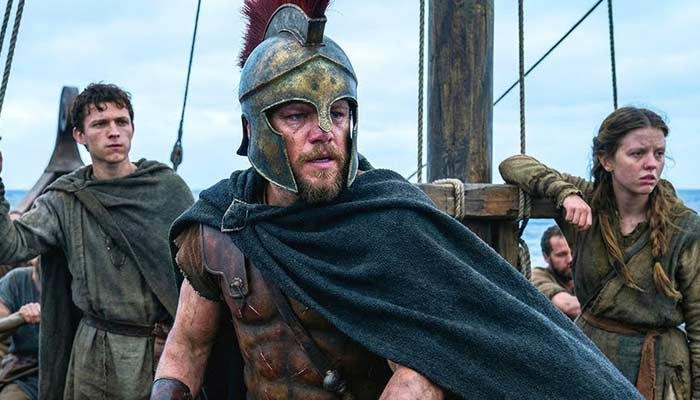
The Odyssey’s cast has something for everyone — Matt Damon as the seasoned veteran leading the charge, trusted to deliver an equally seasoned performance as the story’s protagonist, which he does.
Anne Hathaway commands the Ithaca subplot as Odysseus’s wife, Penelope. With brutish and rogue suitors (among them a delightful Robert Pattinson as the cowardly Antinous and a commanding Corey Hawkins as the bully Polybus) crowding her castle in greedy hopes of securing her hand in marriage, Hathaway displays the perfect blend of a patient composure worthy of a queen and a restless listlessness befitting a faithful and loving wife left behind.
Mia Goth, John Leguizamo, and an inspired Elliot Page performance make for an even more alluring viewing. But then there are those who might steer the viewership’s verdicts apart.
Lupita Nyong'o as Helen of Troy was one part of the casting announcement which further exposed the world’s politically driven partisan turmoil, if one could even believe that. Far from the first non-white actress to play the part (iconic leading lady Eartha Kitt famously portrayed the heroine in a Paris stage production of the story directed by Orson Welles), the Academy Award winner brought a captivating grace to the character — almost like a direct response to the flailing arms complaints from the likes of Elon Musk, who largely led the sorry excuse of a smear campaign against her casting before a single scene was ever screened for the public.
Tom Holland would have been an afterthought among his peers, if not for playing Telemachus, whose character quite literally cannot be escaped for as long as the fable unfolds. Playing Odysseus’s son with a similar neighbourhood friendly vibe associated with his most famous role, Holland just does enough to keep the audience on his side.
Travis Scott opens the film as the Bard, performing the tale of Odysseus’s war heroics, and vanishes into the plot’s periphery as soon as he appears. However, it is an achievement worth celebrating that the rapper making his acting debut is not the one cast member who seems the most out of place.
That would be Charlize Theron — whose tattered clothing reminiscent of a Renaissance-era Greek painting makes for the only indication of her being from the time which the film is set in. Despite her own veteran status, with her only screen appearance being alongside Damon as the hero, there’s something about the way Theron’s hair is styled and the sound of her voice as she delivers her lines, that doesn’t quite feel like she is supposed to be the luring nymph Calypso who deliberately keeps Odysseus in an amnesiac state to stop him from returning to his kingdom, having admittedly fallen in love with him.
Zendaya delivers the goods as the famous goddess Athena — which is to say that she appears for a few fleeting minutes onscreen, looking and sounding like Zendaya. In a way, the casting makes perfect sense; the Emmy-winning actress is supposed to be a common Trojan woman, whose likeness the goddess borrows for appearing to Odysseus, since he had stared her in the face as she was slaughtered by his soldiers during the fall of Troy — at the same time as his men destroyed the head of Athena’s statue within the city’s premises.
Everyone however must keep their eyes peeled for Samantha Morton as the mighty goddess and enchantress Circe, who has something wild in store for Odysseus and his impulsive men.
Full of sound and fury
The tragic and gallant Odyssey fable and its eponymous hero, while unfolding in a mostly traditional pattern onscreen, is best served in its subtlety.
The tale full of sound and fury, certainly not told by an idiot, signifies a quiet determination and lessons fit for a modern audience. The strength of Nolan’s storytelling and grand vision lies in its transformative originality.
Faced with the cyclopean task of adapting an epic well-known to many, the British filmmaker at its helm condensed a few parts and changed others. Circe, played by Samantha Morton as mentioned previously, becomes a woman who looks like any ordinary woman — as opposed to the glamorous enchantress imagined by Homer.
Her part in the story (featuring a strikingly horrific scene involving Odysseus’ men which could rival body horror worthy of Cronenberg, meant in the best way) is accompanied by a tragic lore of violence which could only befall a woman. Instead of trying to outwit her and spending considerable time on Circe’s island as her lover, Odysseus recognises the woe behind the witch, and manages to successfully depart her shores with mutual understanding.
When Odysseus disguises himself to enter his own castle’s walls decades later, he is asked by Telemachus about what he plans to do at the suitors’ banquet.
“Beg. The clearest view of men is from below,” replies the hero.
It is the plain and grounded and the deep humanity within the source material, embellished with myths and monsters larger than any man, which has endeared such ancient texts to countless generations that followed them. Christopher Nolan understands that – and that’s the best thing any review could reveal about The Odyssey (2026).