Nvidia CEO Jensen Huang makes X debut with urgent open-source AI plea
Chip giant, Nvidia, chief warns Washington against restricting open-weight AI models in first-ever social media post
Published July 24, 2026
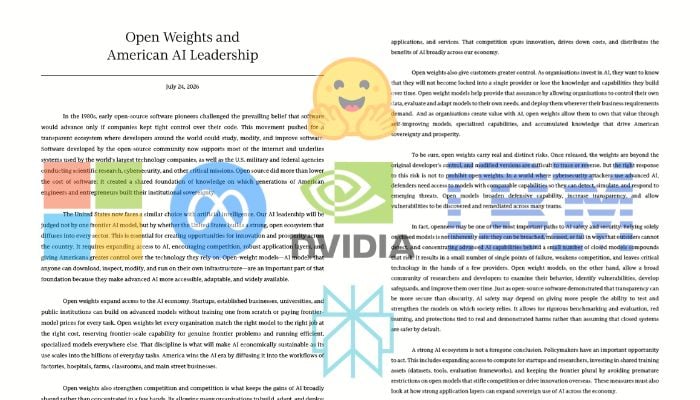
Nvidia CEO Jensen Huang wrote his first post on X (formerly known as Twitter) on Friday, July 24, delivering a critical message “Don’t lock down open artificial intelligence models.”
Huang attached a letter in the post signed by Nvidia and 24 other companies, including Microsoft, Meta, and Hugging Face, defending open-weight AI as essential to American innovation and national security.
The open-weight models enable anyone to download, modify, and reuse advanced AI systems for free, in contrast to proprietary alternatives that remain locked behind corporate gates.
Huang wrote: “AI will transform every industry, power every company, and be built by every country. Open models strengthen safety and cybersecurity, accelerate innovation and diffusion, and enable sovereignty.”
The timing cannot be overlooked. It was just last year when the American government embraced open models in the AI Action Plan as a strategic asset. Today, the U.S. government is considering imposing regulations on Chinese models such as Kimi K3, which has 2.8 trillion parameters, unveiled by Moonshot AI on July 16.
This is not a new problem. The company's move in January 2025 made Nvidia shares drop by almost $600 billion in one day. According to Michael Kratsios, a senior adviser to the White House, Moonshot cloned a U.S. model to make the Kimi K3.
The letter acts as a safety case for openness, arguing that transparent models enable independent testing and faster flaw detection, while closed systems give power in few hands. The letter also defends model distillation (training one model using another’s outputs) as legitimate research, not theft.
Signatories who see strong China-based open-source models as a threat to their security and therefore are not part of this group include OpenAI and Anthropic. Huang’s views put him in conflict with U.S. Treasury Secretary Scott Bessent, who recently raised concerns about possible sanctions against industrial distillation attacks on American intellectual property.
The letter states: “We oppose premature restrictions on open models that stifle competition or drive innovation overseas.” The coming weeks will reveal whether Washington heeds the chip industry’s warning or moves to restrict the very technology it once championed.